

If you’ve spent any time scrolling through personality quizzes online, chances are you’ve stumbled upon the Pooh Pathology Test. It’s one of those fun, slightly nostalgic assessments that instantly pull you back into the soft, honey-scented world of Winnie the Pooh and his friends in the Hundred Acre Wood. But behind the adorable illustrations lies something a little more interesting: a quirky psychological perspective on why we connect with these characters so deeply.
Let’s talk about what this test really is, why people enjoy it so much, and what you can actually learn from it—without taking any of it too seriously.
So, What Exactly Is the Pooh Pathology Test?
The Pooh Pathology Test is a lighthearted personality quiz inspired by the classic characters created by A.A. Milne. Instead of asking you dry psychological questions, it uses the personalities of Pooh, Piglet, Eeyore, Tigger, and others as metaphors for different psychological traits and tendencies.
It’s important to say up front:
This is not a clinical assessment.
It’s not meant to diagnose, label, or replace professional help. It’s more like sitting with a friend and saying, “You know what? I think I might be a bit like Tigger—always bouncing around, doing things before thinking.”
Still, the reason it resonates with so many people is because it mixes familiarity, humor, and gentle introspection—all things that make self-reflection less intimidating.
How the Test Works (And Why It Feels So Accurate)
Most versions of the test, such as the one on IDRlabs, ask around 20–36 questions. These explore everyday emotions and behaviors—how you handle stress, how you respond to change, how energetic or cautious you are, and so on.
Once you answer honestly (which is key!), the test matches you with one of the beloved characters. And here’s where it gets surprisingly insightful: each character is linked to certain psychological tendencies that researchers have analyzed over the years.
A few examples:
🐻 Winnie the Pooh
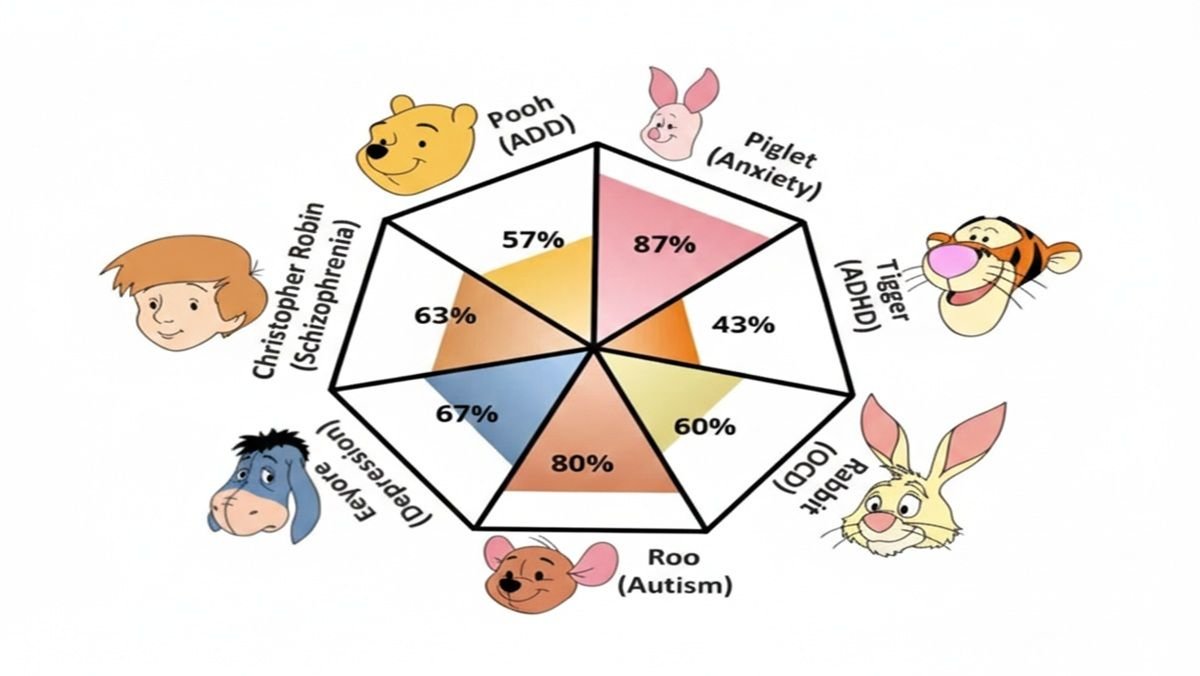
Pooh is simple, kind-hearted, and often blissfully distracted by food—or anything comforting. Psychologists have playfully linked him to traits of obsessive behavior, but not in a dark way. More like that constant, endearing search for honey or something warm and reassuring.
🐷 Piglet
Anxiety personified. Piglet represents those of us who jump a little at sudden noise, overthink worst-case scenarios, or need reassurance more often than others. The test may highlight characteristics similar to Generalized Anxiety Disorder—but again, in a gentle, fictionalized way.
🐴 Eeyore
If you’ve ever related to his “Oh well… that’s life” attitude, you’re not alone. Eeyore is often used as a symbol for depressive tendencies—low energy, pessimism, and difficulty finding joy. Many people surprisingly find him comforting because he makes vulnerability feel valid and human.
🐯 Tigger
Tigger is all enthusiasm, all the time—until he crashes. He mirrors traits often associated with ADHD or impulsivity. If you’re the kind of person who starts ten projects at once or can’t sit still, you might land here.
These associations aren’t meant to label—they’re simply a creative way to talk about mental health traits using characters we grew up loving.
Why Are We So Drawn to This Test?
There’s something almost therapeutic about recognizing ourselves in fictional characters. It softens the edges of self-analysis. Instead of saying, “I have anxious tendencies,” it feels much friendlier to say, “I’m a bit of a Piglet.” That’s the magic of the Pooh Pathology Test—it makes complex emotions approachable.
Many people also find comfort in the idea that every character, despite their quirks or struggles, is deeply loved by their friends. Piglet isn’t told to “stop worrying.” Eeyore isn’t shamed for feeling low. Tigger isn’t criticized for being too much. They’re accepted, supported, and valued.
In a world where mental health discussions can feel heavy, this whimsical lens is refreshing.
A Gentle Reminder Before You Take It
As fun and insightful as the test can feel, it’s crucial to remember:
- It’s not a diagnostic tool.
- It’s for self-reflection, not self-judgment.
- It’s meant to entertain and create awareness—not define you.
If you resonate strongly with a character, think of it as a starting point for understanding your emotional patterns, not as a label to attach to your identity.
Final Thoughts: A Sweet Step Toward Self-Discovery
The Pooh Pathology Test isn’t just a nostalgic distraction. It’s a playful doorway into understanding ourselves a little better. Whether you identify with Piglet’s worries, Tigger’s boundless energy, Eeyore’s quiet sadness, or Pooh’s simple joys, the message remains the same:
Every personality has value. Every emotion has a story. And each of us—like the characters of the Hundred Acre Wood—is worthy of compassion, understanding, and acceptance.
So if you’re curious, take the test for fun. Reflect on the results. Smile at them. And remember: you’re more than any quiz can capture—but sometimes, a little honey-sweet insight is exactly what we need.
Read Also: