
Have you ever had one of those arguments where you were absolutely sure you were right, only to find out later that your memory was off? Maybe you remember a movie quote one way, or you could swear a brand name was spelled differently. If that sounds familiar, you’ve probably brushed up against something psychologists call the Mandela Effect.
What makes it so interesting isn’t that one person remembers something wrong. That happens all the time. The strange part is when huge groups of people remember the exact same thing incorrectly.
We usually trust our memories. They help us make sense of the world, after all. But memory is not a perfect recording stored in the brain. It’s more like a story our mind keeps editing every time we bring it back up.
In this article, we’ll look at what the Mandela Effect is, why it happens, what psychology says about it, some famous examples, Indian examples, and whether there’s any real proof behind the mystery.
Key Takeaways
- The Mandela Effect happens when a large group of people remembers something differently from how it actually happened.
- Human memory is flexible, which means false memories can feel completely real.
- Repeated exposure, suggestion, and the internet all play a big role in spreading shared misremembering.
What is the Mandela Effect?
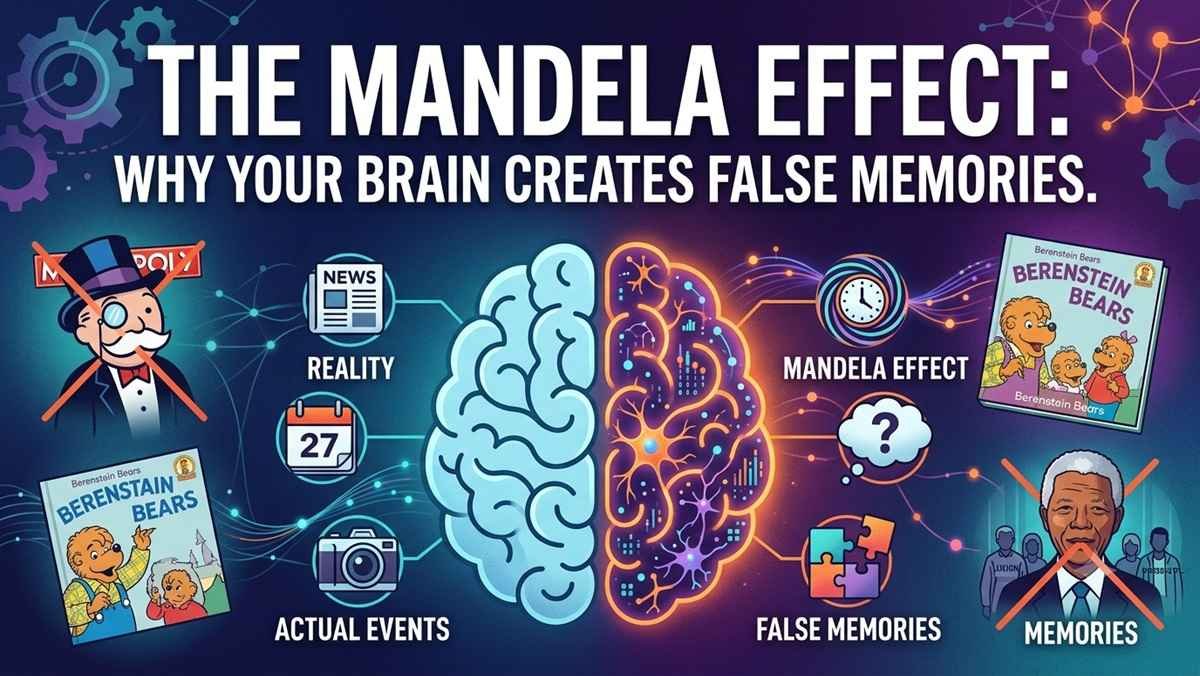
The Mandela Effect is a psychological phenomenon where many people remember the same event, fact, logo, quote, or name incorrectly.
The term was first introduced in 2009 by researcher Fiona Broome after she noticed that many people, including herself, believed Nelson Mandela had died in prison in the 1980s.
In reality, Mandela was released from prison in 1990, later became South Africa’s president, and died in 2013.
What surprised Broome wasn’t just that she remembered it wrong. It was that so many other people shared the same false memory.
Since then, the Mandela Effect has become one of the internet’s favorite psychological mysteries.
Why is it called the Mandela Effect?
The name is actually pretty simple.
It’s called the Mandela Effect because the phenomenon was first noticed through the widespread false memory about Nelson Mandela’s death.
Fiona Broome found that many people remembered seeing news coverage of Mandela’s funeral years before he actually died. Some even remembered speeches and reports that never happened.
That shared false memory led her to coin the term “Mandela Effect.” The name stuck, and now it’s used everywhere from psychology discussions to social media debates.
Mandela Effect Psychology: Why Does Your Brain Create False Memories?
The Mandela Effect is less about having a “bad memory” and more about how memory actually works.
A lot of people think memory works like a video camera. You store something once, and later you just play it back. But that’s not how the brain works. Every time we remember something, we rebuild it.
Psychologists think several things can lead to the Mandela Effect.
1. False Memories
Sometimes the brain stores information incorrectly.
Later, when you try to remember it, your mind fills in the blanks with details that seem to make sense.
After enough time, that version starts to feel completely real.
2. Confabulation
Confabulation is not the same as lying.
It happens when the brain unknowingly fills in missing pieces of memory with something believable.
The person truly believes the memory is accurate.
3. Suggestion
If you hear the same incorrect detail over and over, your brain may eventually accept it as true.
That’s why repeated exposure to misinformation can change the way people remember things.
4. Pattern Recognition
Our brains love patterns.
If one spelling or phrase looks more familiar, the brain may quietly “fix” it, even if the original version was correct.
For example:
- Berenstain becomes Berenstein.
- Froot becomes Fruit.
- Looney Tunes becomes Looney Toons.
These versions may feel more natural, which is exactly why they’re easier to remember incorrectly.
What is the Mandela effect example?
One of the most famous examples is The Berenstain Bears.
A lot of adults confidently remember reading The Berenstein Bears as kids.
But the books have always been spelled Berenstain.
People often insist they saw the “stein” version on the cover.
Still, no official copies with that spelling exist.
That’s why this example is one of the best-known Mandela Effects. So many people share the same wrong memory that it feels almost impossible.
Mandela Effect Examples That Continue to Confuse People
Here are some of the most talked-about Mandela Effects.
“Luke, I am your father.”
Many people remember Darth Vader saying:
“Luke, I am your father.”
But the actual line is:
“No, I am your father.”
Mirror, Mirror on the Wall
A lot of people remember:
Mirror, mirror on the wall…
But the original line is:
Magic mirror on the wall…
Pikachu’s Tail
A surprising number of Pokémon fans remember Pikachu having a black tip on its tail.
It never did.
Only the ears have black tips.
Monopoly Man’s Monocle
Many people picture Mr. Monopoly wearing a monocle.
He never has.
People often mix him up with Mr. Peanut.
Fruit of the Loom Logo
This is one of the internet’s favorite examples.
A lot of people remember fruit spilling out of a cornucopia in the Fruit of the Loom logo.
But the official logo has never included one.
Curious George’s Tail
Many people remember Curious George having a tail.
He has always been tailless.
Looney Tunes
A lot of adults swear it was:
Looney Toons
But the official title has always been:
Looney Tunes
Best Examples of Mandela Effect
Some Mandela Effects have become especially famous because so many people remember them so confidently.
Popular examples include:
- Nelson Mandela dying in prison
- The Berenstain Bears spelling
- “Luke, I am your father”
- “Mirror, Mirror on the Wall”
- Monopoly Man’s monocle
- Fruit of the Loom logo
- Pikachu’s black-tipped tail
- Curious George’s tail
- Looney Tunes spelling
- C-3PO being entirely gold
These examples still pop up in conversations, videos, and social media posts all the time.
What are the top 10 Mandela effects?
If you’re just getting into the topic, these are usually considered the Top 10 Mandela Effects:
- Nelson Mandela’s death
- The Berenstain Bears spelling
- “Luke, I am your father”
- “Mirror, Mirror on the Wall”
- Monopoly Man’s missing monocle
- Fruit of the Loom logo
- Pikachu’s tail
- Curious George’s tail
- Looney Tunes spelling
- C-3PO’s silver leg
Each one shows how confidently large groups of people can remember something that never actually happened.
What is the Mandela effect in India?
The Mandela Effect isn’t just a Western thing.
Indian internet users have also shared plenty of examples over the years, although many of them come from pop culture rather than formal psychological studies.
Some commonly discussed Indian Mandela Effects include:
- Remembering Bollywood dialogues differently from the original movie
- Misremembering famous 1990s advertisements
- Confusing the lyrics of classic Hindi songs
- Recalling television serial logos differently
- Remembering cricket commentary with words that were never actually spoken
A lot of Bollywood quotes become popular in altered forms because comedians, memes, TV shows, and everyday conversations repeat them incorrectly.
Over time, those repeated versions can feel more familiar than the original.
Mandela Effect Theory: Why Do Some People Think Something Stranger Is Happening?
Psychologists explain the Mandela Effect through memory science, but not everyone is satisfied with that explanation.
A few alternative theories have become popular online.
Parallel Universes
Some people believe we sometimes shift between parallel realities.
According to this idea, people remember events from another universe instead of this one.
There is no scientific evidence for this theory.
Simulation Theory
Another theory says we live inside a computer simulation.
In this version, small “updates” to reality create glitches that people notice.
It’s an interesting idea, but it remains speculative and unproven.
Quantum Reality
Some online discussions connect the Mandela Effect to quantum mechanics.
Scientists generally do not accept this explanation because there’s no evidence linking quantum physics to shared false memories.
Mandela Effect Proof: Is There Any Scientific Evidence?
A lot of people search for Mandela Effect proof, hoping to find evidence of alternate realities or timeline shifts.
Right now, there is no verified scientific proof that parallel universes, reality changes, or timeline jumps explain the Mandela Effect.
What we do have is a lot of research in cognitive psychology showing that memory is reconstructive, not perfect. Studies have shown that suggestion, repeated misinformation, and expectations can all shape how people remember the past.
That doesn’t mean your memories are fake. It just means memory is flexible, and sometimes it changes without us noticing.
How the Internet Makes Mandela Effects More Common
Before social media, people usually kept strange memories to themselves.
Now, one post can reach millions in a few hours.
Imagine someone writes:
“Does anyone else remember Pikachu having a black tail?”
And thousands of people reply:
“Yes!”
Once people start talking about the same incorrect memory, confidence grows.
The more often something is repeated, the more believable it feels.
The internet doesn’t necessarily create false memories from scratch, but it definitely helps spread and strengthen them.
Researchers have also found that false information often spreads faster than accurate information online because it feels more surprising, emotional, and memorable.
100 Mandela Effect List: Where Can You Find More Examples?
A lot of websites publish a 100 Mandela Effect list with examples from movies, cartoons, books, logos, celebrities, history, and brands.
These lists can be fun to explore, but it’s best to look at them with curiosity instead of assuming every example points to something mysterious.
Some are real examples of collective false memory. Others are just misunderstandings or internet rumors that got repeated enough times to sound true.
If you’re checking out long Mandela Effect lists, it’s always smart to look at original sources, official logos, or archived material before treating something as proof.
Why Our Brain Prefers Familiar Stories
One of the most interesting things about the brain is that it cares more about meaning than perfect accuracy.
When we remember something, the brain often asks:
“What makes the most sense?”
instead of
“What happened exactly?”
That shortcut helps us make quick decisions in everyday life.
But it also means small memory mistakes can stick around for a long time.
That’s why millions of people can honestly remember the same wrong detail.
Should You Worry About False Memories?
Not really.
Having a Mandela Effect moment doesn’t mean your memory is broken.
It just means your brain is doing what human brains do.
Everyone develops false memories sometimes.
Psychologists have shown that even smart people, eyewitnesses, and experts can remember things incorrectly with complete confidence.
The real lesson is to stay open-minded.
Being sure about something doesn’t always mean being right.
Final Thoughts
The Mandela Effect is a reminder that memory is one of the most fascinating—and imperfect—parts of being human. Some people love the idea of alternate realities or parallel universes, but the strongest explanation still comes from psychology.
Our brains don’t replay the past like a movie. They rebuild it. And while doing that, suggestion, expectations, repetition, and social influence can quietly change what we think we remember. In a world where misinformation spreads fast, shared false memories are easier to notice than ever before.
Whether you’re interested in movie quotes, logo changes, or childhood memories that feel strangely different, the Mandela Effect teaches us something important: our minds are powerful, but they’re not flawless. Understanding how memory works helps us think more clearly and question things a little more carefully.
So the next time you’re completely sure about a memory that turns out to be wrong, don’t be too hard on yourself. You may not be alone—you may have just experienced the strange and fascinating Mandela Effect.
Read Also:
https://thebrainalert.com/can-sea-buckthorn-improve-your-mental-health/