

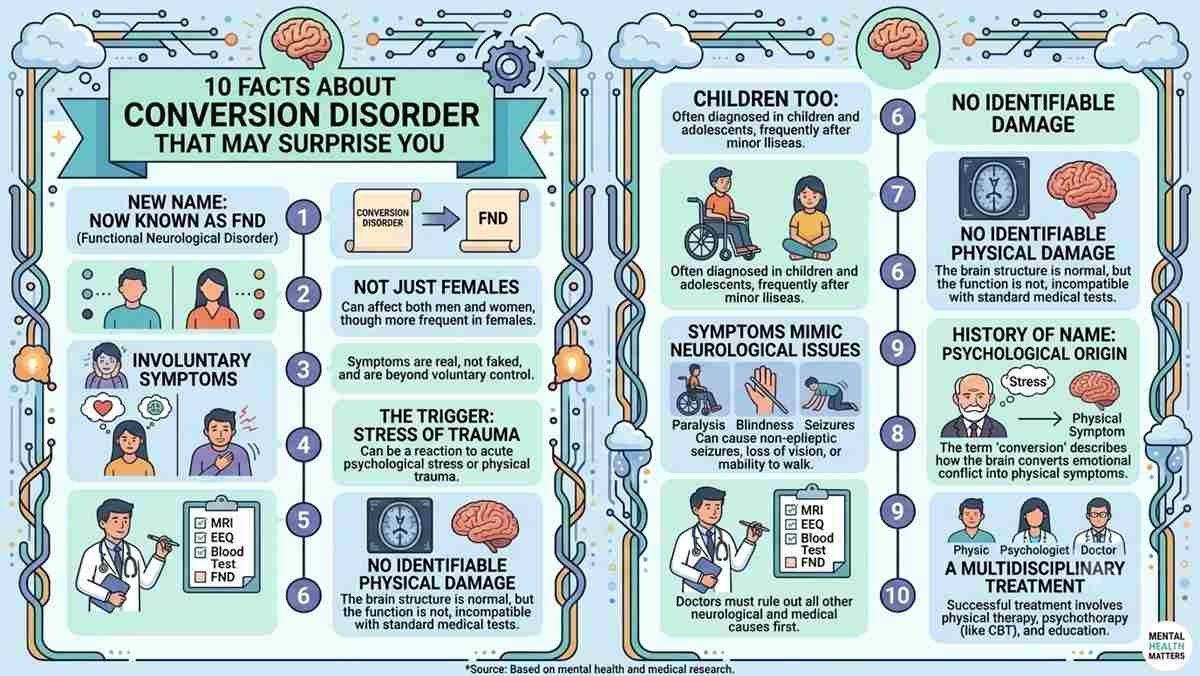
When people experience unexplained physical symptoms, they often assume there must be a hidden medical illness causing them. But sometimes, the body can develop very real symptoms even when doctors cannot find structural damage or disease. One condition that perfectly illustrates this complex connection between the mind and body is Conversion Disorder, now more commonly known as Functional Neurological Disorder (FND).
For decades, conversion disorder was misunderstood. Many people believed the symptoms were “all in someone’s head” or that affected individuals were pretending to be sick. Modern neuroscience has completely changed that view.
Today, experts recognize conversion disorder as a genuine neurological condition that can significantly affect a person’s quality of life. The symptoms are real, the distress is real, and treatment can make a meaningful difference.
In this article, we’ll explore 10 surprising facts about conversion disorder, answer common questions, and explain what current research says about this often misunderstood condition.
Table of Contents
ToggleWhat Is a Conversion Disorder?
One of the most frequently searched questions is:
What is a conversion disorder?
Conversion disorder is a condition in which a person develops neurological symptoms that cannot be explained by traditional medical testing. These symptoms may affect movement, sensation, speech, vision, hearing, or even consciousness.
Healthcare professionals now commonly refer to it as Functional Neurological Disorder (FND) because the problem involves how the brain functions rather than damage to the brain itself.
Think of it like a software problem rather than a hardware problem.
A computer can stop working properly even when all its physical components are intact. Similarly, in conversion disorder, the brain’s structure is usually normal, but the communication between the brain and body becomes disrupted.
The result is real physical symptoms that the person cannot consciously control.
Fact #1: The Symptoms Are Real, Not Imagined
One of the biggest misconceptions about conversion disorder is that people are faking their symptoms.
This belief is not supported by modern research.
People with conversion disorder can experience:
- Paralysis
- Tremors
- Blindness
- Speech difficulties
- Seizure-like episodes
- Weakness
- Loss of sensation
- Balance problems
These symptoms are not voluntary.
The person is not choosing to experience them.
Brain imaging studies have shown differences in activity patterns in certain brain regions among people with Functional Neurological Disorder. These findings help explain why symptoms occur even when standard scans appear normal.
The suffering is real, and so are the symptoms.
Fact #2: Conversion Disorder Symptoms Can Mimic Serious Neurological Diseases
Conversion Disorder Symptoms
Many conversion disorder symptoms closely resemble conditions such as:
- Stroke
- Epilepsy
- Multiple sclerosis
- Parkinson’s disease
- Neuromuscular disorders
This is one reason diagnosis can take time.
Some common symptoms include:
Movement Symptoms
- Tremors
- Muscle weakness
- Abnormal gait
- Coordination problems
Sensory Symptoms
- Numbness
- Tingling
- Vision changes
- Hearing disturbances
Cognitive Symptoms
- Brain fog
- Memory problems
- Difficulty concentrating
Speech Symptoms
- Stuttering
- Slurred speech
- Voice changes
Because these symptoms can resemble serious illnesses, doctors often perform extensive testing before making a diagnosis.
Fact #3: Stress Is Not Always the Cause
What Is the Cause of Conversion Disorder?
For many years, experts believed conversion disorder happened only because of psychological stress or trauma.
While stress can contribute, the reality is more complicated.
Current research suggests multiple factors may play a role, including:
- Emotional stress
- Trauma
- Physical injury
- Chronic pain
- Infections
- Neurological vulnerabilities
- Anxiety disorders
- Depression
Some individuals develop conversion disorder after a stressful event.
Others develop symptoms without any obvious emotional trigger.
This is why modern medicine no longer views conversion disorder as purely psychological.
Instead, experts see it as a complex interaction between the brain, nervous system, emotions, and physical experiences.
Fact #4: Seizures Can Occur Even Without Epilepsy
Conversion Disorder With Seizures
One of the most dramatic forms of conversion disorder involves seizure-like episodes known as:
Psychogenic Non-Epileptic Seizures (PNES).
These events may look nearly identical to epileptic seizures.
A person may:
- Shake uncontrollably
- Fall to the ground
- Lose awareness
- Experience unusual movements
However, during testing, doctors often find no abnormal electrical activity associated with epilepsy.
This does not mean the seizure is fake.
The episode is genuine and can be extremely frightening for both the patient and family members.
PNES is now considered one of the most common manifestations of Functional Neurological Disorder.
Fact #5: Children and Adults Can Both Develop It
Many people assume conversion disorder only affects adults.
In reality, it can occur at almost any age.
Children, teenagers, and adults have all been diagnosed with the condition.
Young people may experience symptoms such as:
- Difficulty walking
- Sudden weakness
- Tremors
- Non-epileptic seizures
Early diagnosis is especially important because younger individuals often respond very well to treatment.
Fact #6: Some People Recover Completely
Is There a Cure for Conversion Disorder?
Another common question is:
Is there a cure for conversion disorder?
The answer is encouraging.
Many people experience substantial improvement and some recover completely.
Recovery depends on several factors:
- Early diagnosis
- Appropriate treatment
- Strong support systems
- Good understanding of the condition
- Participation in therapy
Not everyone follows the same recovery path.
Some improve within weeks.
Others require months or years of treatment.
Even when symptoms persist, many individuals learn effective ways to manage them and regain independence.
Fact #7: Treatment Often Involves More Than Medication
Conversion Disorder Treatment
Unlike many neurological disorders, medication alone is usually not the primary treatment.
Instead, treatment often combines several approaches.
Cognitive Behavioral Therapy (CBT)
CBT helps people understand the connection between thoughts, emotions, and physical symptoms.
Physical Therapy
Physical therapy can help restore movement, balance, and coordination.
Occupational Therapy
This helps people improve daily functioning.
Speech Therapy
Useful for speech or swallowing difficulties.
Stress Management
Reducing stress may decrease symptom severity.
Treatment of Coexisting Conditions
Addressing anxiety, depression, or chronic pain often improves outcomes.
The goal is not simply to reduce symptoms but to retrain the brain’s communication pathways.
Fact #8: Diagnosis Is Based on Positive Signs, Not Just Normal Tests
Years ago, doctors often diagnosed conversion disorder only after ruling out every possible medical condition.
Today, diagnosis is becoming more sophisticated.
Instead of relying solely on normal test results, neurologists look for specific clinical signs that suggest Functional Neurological Disorder.
Examples include:
- Inconsistent weakness patterns
- Symptoms that improve with distraction
- Certain movement characteristics
- Specific examination findings
This approach helps make diagnosis more accurate and faster.
Fact #9: Conversion Disorder Is More Common Than Many People Realize
Many people have never heard of conversion disorder.
Yet it is surprisingly common.
Studies suggest Functional Neurological Disorder is one of the most frequent reasons people visit neurology clinics.
Despite its prevalence, awareness remains limited.
This lack of awareness contributes to:
- Delayed diagnosis
- Misunderstanding
- Social stigma
- Emotional distress
Greater public education is helping change these perceptions.
Fact #10: The Name Has Changed, but the Condition Remains the Same
What Is Another Name for Conversion Disorder?
Modern healthcare providers increasingly use the term:
Functional Neurological Disorder (FND)
or
Functional Neurological Symptom Disorder (FNSD)
The older term “conversion disorder” originated from the theory that emotional conflicts were converted into physical symptoms.
Because current research shows the condition is more complex than that explanation, many experts prefer the newer terminology.
Still, both names often refer to the same disorder.
Conversion Disorder Example
What Is an Example of Conversion Disorder in Real Life?
Imagine a college student who experiences intense stress before important examinations.
One morning, she wakes up unable to move one leg properly.
She is rushed to the hospital.
Doctors perform:
- Blood tests
- MRI scans
- Neurological examinations
All results appear normal.
Yet her symptoms are genuine.
She struggles to walk and feels frightened.
Eventually, specialists diagnose Functional Neurological Disorder.
After receiving physical therapy and psychological support, her mobility gradually improves.
This is a simplified example, but it demonstrates how real and disabling symptoms can occur without structural neurological disease.
Conversion Disorder Causes
Although researchers continue studying the condition, several potential contributing factors have been identified:
- Childhood adversity
- Trauma
- Anxiety
- Depression
- Chronic stress
- Physical injury
- Chronic pain conditions
- Certain neurological illnesses
Importantly, not everyone with conversion disorder has experienced trauma.
The condition can develop in many different circumstances.
Is Conversion Disorder Serious?
A common concern is:
Is Conversion Disorder Serious?
The answer is yes.
While conversion disorder is not usually life-threatening, it can significantly affect daily life.
People may struggle with:
- Employment
- Education
- Relationships
- Driving
- Physical independence
Some individuals become unable to work or perform everyday activities.
The emotional impact can be substantial as well.
Because symptoms are often misunderstood, people may feel isolated or dismissed.
This is why early diagnosis and treatment are so important.
Who Is Most at Risk for Conversion Disorder?
Who Is Most at Risk for Conversion Disorder?
Research suggests higher risk among individuals who have:
- Anxiety disorders
- Depression
- Chronic pain
- Previous trauma
- High stress levels
- Certain neurological conditions
Women are diagnosed more frequently than men, although the condition can affect anyone.
Children and adolescents can also develop Functional Neurological Disorder.
Conversion Disorder DSM-5
Conversion Disorder DSM-5 Criteria
The Diagnostic and Statistical Manual of Mental Disorders (DSM-5) refers to the condition as:
Functional Neurological Symptom Disorder.
According to DSM-5, diagnosis generally involves:
- One or more symptoms affecting movement or sensation.
- Clinical findings that show incompatibility with recognized neurological diseases.
- Symptoms that cause significant distress or impairment.
- Symptoms not better explained by another medical condition.
These criteria help clinicians distinguish Functional Neurological Disorder from other neurological illnesses.
Conversion Disorder vs Somatic Symptom Disorder
Conversion Disorder vs Somatic Symptom Disorder
These conditions are sometimes confused, but they are different.
Conversion Disorder
The primary issue involves neurological symptoms such as:
- Paralysis
- Tremors
- Seizure-like episodes
- Speech problems
Somatic Symptom Disorder
The primary feature is excessive concern about physical symptoms, regardless of whether a medical cause exists.
In conversion disorder, the neurological symptoms themselves are the defining feature.
In somatic symptom disorder, the focus is more on distress and preoccupation related to symptoms.
Both conditions are genuine and deserve compassionate treatment.
Conversion Disorder PPT
Conversion Disorder PPT: Key Points for Students and Professionals
If you’re preparing a conversion disorder PPT presentation, consider including:
- Definition of Functional Neurological Disorder
- Historical background
- Common symptoms
- Risk factors
- Diagnostic criteria
- DSM-5 classification
- Treatment options
- Prognosis
- Case studies
- Current research findings
These topics provide a strong overview for educational presentations.
What Are the 7 Types of Mental Disorders?
What Are the 7 Types of Mental Disorders?
Mental health professionals classify mental illnesses into many categories, but some major groups include:
- Anxiety disorders
- Mood disorders
- Psychotic disorders
- Personality disorders
- Trauma-related disorders
- Neurodevelopmental disorders
- Somatic symptom and related disorders
Conversion disorder falls within the broader category of somatic symptom and related disorders in psychiatric classification systems.
Living With Conversion Disorder
Receiving a diagnosis of conversion disorder can bring mixed emotions.
Some people feel relief because they finally have an explanation.
Others feel confused because the diagnosis is unfamiliar.
What matters most is understanding that:
- The symptoms are real.
- Recovery is possible.
- Effective treatments exist.
- You are not imagining the condition.
Building a supportive healthcare team can make a tremendous difference.
Final Thoughts
Conversion disorder, now more commonly known as Functional Neurological Disorder, remains one of the most misunderstood conditions in medicine. Yet research continues to reveal just how real and complex it truly is.
The disorder sits at the fascinating intersection of neurology, psychology, and brain science. While symptoms may not show up on traditional scans, they can have a profound effect on a person’s life.
The good news is that awareness is growing. Healthcare providers now better understand how the condition works, and treatment approaches continue to improve.
If you or someone you know is experiencing unexplained neurological symptoms, seeking evaluation from qualified healthcare professionals is an important first step. Early diagnosis, proper treatment, and compassionate support can significantly improve outcomes.
Most importantly, remember this: conversion disorder is not a sign of weakness, attention-seeking, or personal failure. It is a legitimate medical condition that deserves understanding, respect, and appropriate care.
Read Also:
https://thebrainalert.com/10-habits-that-boost-brain-power/