

Key Takeaways
- Overthinking usually starts when ordinary thoughts turn into endless worry, and the fastest way to interrupt it is to notice the pattern early.
- Simple tools like grounding, breathing, movement, and self-talk can pull your attention away from fear and back into the present.
- If overthinking starts affecting your sleep, mood, work, or relationships, talking to a mental health professional can make a real difference.
Have You Ever Felt Like Your Mind Just Won’t Shut Off?
It’s the middle of the night. Your body wants rest, but your brain seems to have other plans.
You keep replaying a conversation from earlier. You wonder if you sounded rude, awkward, or careless. Then your thoughts jump to tomorrow’s tasks, your money, your health, your future, and every possible thing that could go wrong. Before long, your mind has built an entire disaster movie out of nothing.
If that sounds familiar, you’re definitely not the only one.
Most people overthink now and then. The trouble starts when thinking stops being useful and turns into a loop of worry that never leads anywhere. Instead of helping you solve a problem, it keeps you tense, restless, and stuck in your own head.
The good news? You do not need a perfect routine or a long meditation session to calm your mind. Sometimes, a few seconds is enough to interrupt the spiral before it takes over.
Let’s look at practical, realistic ways to stop overthinking and get your thoughts back under control.
Why Do We Overthink?
Your brain is not trying to ruin your day.
It is trying to protect you.
Long ago, being alert to danger helped people survive. Today, though, the brain often treats everyday situations—like sending a message, making a choice, or having an uncomfortable conversation—as if they were emergencies.
Instead of moving on, your mind keeps circling the same issue.
You might notice yourself:
- Repeating the same thought again and again
- Imagining every possible outcome
- Worrying about things you cannot control
- Doubting every decision you make
- Replaying embarrassing moments
- Fixating on mistakes from the past
The strange thing is that overthinking can feel useful.
It can feel like preparation.
But in reality, it often feeds anxiety instead of solving anything.
The goal is not to stop thinking altogether.
The goal is to notice when your thoughts are helping you—and when they are just keeping you trapped.
How to Immediately Stop Overthinking?
When you catch your mind spinning, do not try to force yourself to “just stop thinking.”
That usually makes things worse.
Instead, interrupt the pattern.
Step 1: Notice What’s Happening
Pause and say to yourself:
“I’m overthinking right now.”
That simple sentence creates a little space between you and the thought.
You stop being inside the thought and start observing it.
Step 2: Ask One Honest Question
Ask:
“Is this helping me solve something, or am I just worrying?”
If your thoughts are not leading to action, they are probably leading to rumination.
That question alone can weaken the spiral.
Step 3: Do Something Physical
Move your body.
Stand up.
Stretch your arms.
Take a sip of water.
Walk to another room.
Take one slow breath.
Physical movement reminds your brain that you are here, now—not trapped in an imagined future.
How to Relieve Stress in 10 Seconds?
Sometimes you do not have time for a long calming routine.
Luckily, your body can respond to calm signals very quickly.
Try this simple breathing reset.
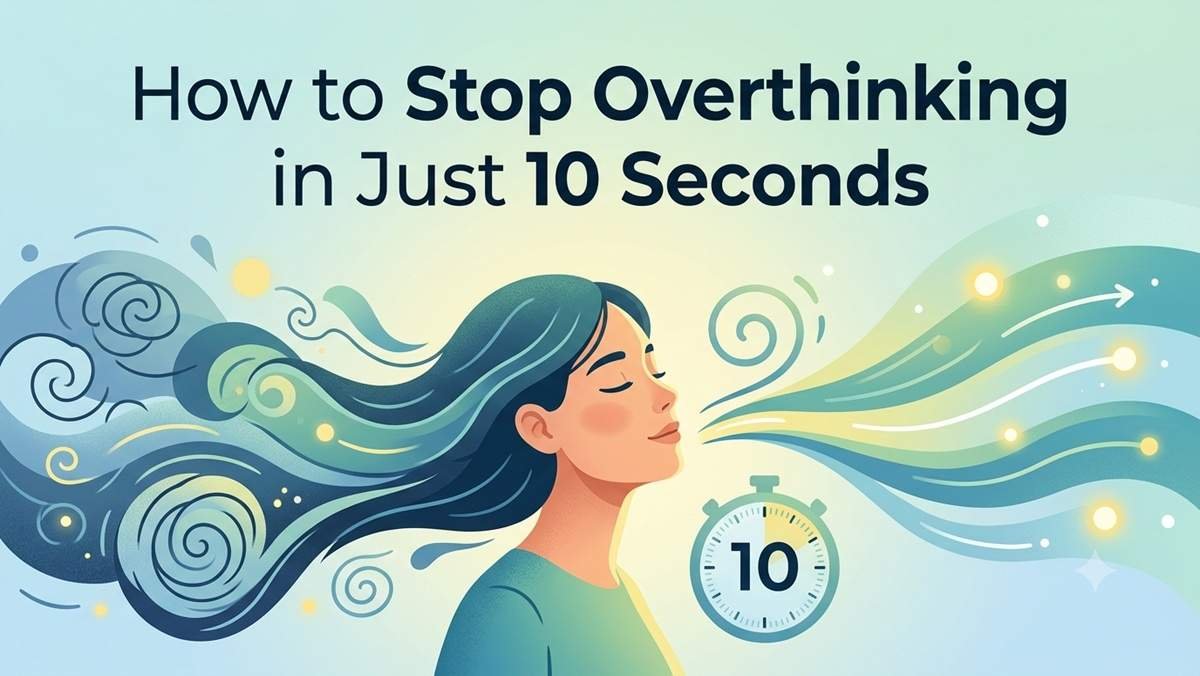
The 10-Second Reset
- Breathe in slowly through your nose for four seconds.
- Hold gently for two seconds.
- Breathe out slowly through your mouth for four seconds.
While you do that:
- Drop your shoulders.
- Relax your jaw.
- Smooth out your forehead.
- Let your hands soften.
This sends a quiet message to your nervous system:
“I’m okay right now.”
When your body settles, your thoughts often slow down too.
The Biggest Mistake People Make When Overthinking
A lot of people think every thought needs to be solved.
It doesn’t.
Picture yourself standing next to a busy road.
Cars keep passing by.
You do not run after every single one.
Thoughts work the same way.
Some deserve attention.
Many are just noise.
One of the healthiest habits you can build is learning to let unhelpful thoughts pass without grabbing onto them.
Understanding the Difference Between Thinking and Overthinking
Healthy thinking sounds like this:
“I have a presentation tomorrow, so I’ll spend half an hour preparing.”
Overthinking sounds more like this:
“What if I forget everything? What if people laugh? What if I mess up? What if this proves I’m not good enough?”
One leads to action.
The other leads to anxiety.
If you are not sure which one you are doing, ask yourself:
“Am I solving this, or am I replaying it?”
That one question can stop a spiral before it grows.
Why Your Brain Loves Worst-Case Scenarios
Have you ever noticed how your mind rarely jumps to the middle ground?
Instead, it goes straight to the worst possible outcome.
That is called the negativity bias.
Your brain naturally pays more attention to danger than to comfort because, for most of human history, that helped people survive.
Today, that same instinct can show up as worries about:
- Losing a job
- Failing a test
- Relationship problems
- Money trouble
- Health concerns
- Feeling embarrassed in public
Most of those fears never actually happen.
But your body still reacts as if they are happening right now.
That is one reason overthinking feels so draining.
The Hidden Cost of Overthinking
Overthinking does more than wear you out mentally.
It can affect almost every part of your life.
You may notice:
- Trouble falling asleep
- Constant tiredness
- Difficulty focusing
- More anxiety
- Irritability
- Lower confidence
- Trouble making decisions
- Less productivity
Ironically, people who overthink are often trying to make the “best” choice.
But perfectionism can freeze you in place.
Keep this in mind:
A good decision made today is usually better than a perfect decision made too late.
What Is the 3-3-3 Rule for Overthinking?
One of the easiest ways to calm a racing mind is the 3-3-3 rule.
It works especially well when anxiety makes you feel disconnected from the present.
Here’s how to do it.
Step One
Look around and name three things you can see.
For example:
- A lamp
- A notebook
- A chair
Step Two
Listen carefully and notice three sounds.
Maybe you hear:
- A fan
- Birds outside
- A car passing by
Step Three
Move three parts of your body.
You could:
- Wiggle your toes
- Roll your shoulders
- Open and close your hands
This grounding exercise pulls your attention away from your thoughts and back into your surroundings.
It does not erase anxiety completely, but it can make it feel much smaller.
How to Stop Overthinking in One Minute?
If you have sixty seconds, you have enough time to calm your mind a little.
Try this quick reset.
Minute One
First 20 seconds: Take three slow breaths.
Next 20 seconds: Ask yourself:
“What is actually in my control right now?”
Final 20 seconds: Do one small thing.
Send the text.
Write the first sentence.
Drink some water.
Step outside.
Small actions break the freeze.
Action creates movement.
Movement quiets the mind.
Healthy Distractions That Actually Help
Some people think distraction is always a bad thing.
Not necessarily.
A healthy distraction gives your brain a break without making the problem worse.
Good options include:
- Taking a short walk
- Gardening
- Cooking something simple
- Listening to calming music
- Reading a few pages of a book
- Doing a puzzle
- Exercising
- Calling someone you trust
The point is not to avoid life forever.
The point is to give your mind a little breathing room so it can come back clearer.
Challenge Negative Thoughts
One of the best ways to reduce overthinking is to question your thoughts instead of automatically believing them.
Remember this:
A thought is not the same thing as a fact.
Let’s say your mind tells you:
“Everyone thinks I’m awkward.”
Pause and ask:
- What proof do I actually have?
- Did someone say that directly?
- Is there another explanation?
Then try replacing the thought with something more balanced.
Instead of:
“I always embarrass myself.”
Try:
“I feel nervous sometimes, but that does not mean everyone is judging me.”
Balanced thinking is usually more honest than extreme optimism or constant self-criticism.
Practice Self-Acceptance
A lot of overthinking comes from harsh self-judgment.
People replay mistakes.
They dwell on regrets.
They wish they had said something different or acted better.
Self-acceptance does not mean pretending mistakes do not matter.
It means understanding that being human includes making them.
Ask yourself:
- What did I learn?
- What would I say to a friend in this situation?
- Can I let myself move forward?
Try to treat yourself with the same patience you would offer someone you care about.
Meditation Can Calm a Busy Mind
Meditation is not about making your mind completely blank.
It is about noticing when your attention drifts and gently bringing it back.
Even ten minutes a day can help reduce repetitive thinking.
A simple practice looks like this:
- Sit somewhere comfortable.
- Focus on your breathing.
- Notice when your thoughts wander.
- Bring your attention back without judging yourself.
Over time, this helps you catch overthinking earlier, before it turns into a full spiral.
Improve Your Communication Skills
It may surprise you, but poor communication often feeds overthinking.
You might spend hours wondering:
- “Did they misunderstand me?”
- “Should I have said that differently?”
- “Are they upset with me?”
Learning to speak clearly, ask questions, express your needs, and set boundaries can reduce a lot of unnecessary mental replay.
When communication improves, confidence usually grows too.
Signs You’re Overthinking
Not sure whether you are overthinking?
Common signs include:
- Replaying conversations over and over
- Imagining worst-case scenarios constantly
- Feeling unable to relax
- Second-guessing every decision
- Feeling mentally drained
- Worrying about things you cannot control
- Losing sleep because your mind will not slow down
If several of these sound familiar, you may be stuck in an overthinking loop.
Common Overthinking Patterns
Overthinking does not always look the same.
Here are a few common patterns.
All-or-Nothing Thinking
Everything feels like total success or total failure.
Catastrophizing
Your mind immediately jumps to the worst possible outcome.
Overgeneralizing
One bad experience makes you believe it will always happen that way.
Once you can spot these patterns, they become much easier to challenge.
Therapy Can Help
If overthinking starts affecting your work, relationships, sleep, or overall happiness, it may be time to talk to a mental health professional.
Therapy is not only for major crises.
It is also a practical way to learn healthier ways of thinking.
A therapist can help you:
- Challenge negative thoughts
- Reduce anxiety
- Build emotional strength
- Learn mindfulness tools
- Improve coping skills
- Create healthier habits
Asking for support is not weakness.
It is a smart and courageous step.
Daily Habits That Reduce Overthinking
Small habits, repeated often, can make a big difference.
Try to:
- Get enough sleep
- Move your body regularly
- Cut back on too much social media
- Practice gratitude
- Spend time outside
- Write down your thoughts
- Stay close to supportive people
- Focus on progress instead of perfection
Consistency matters more than intensity.
Final Thoughts
Overthinking can trick you into believing that thinking harder will solve everything.
But more thinking is not always the answer.
Sometimes the best thing you can do is pause, breathe, question the story in your head, and take one small step forward.
You do not need to control every thought that enters your mind.
You only need to decide which thoughts deserve your attention.
The next time your mind starts racing, remember this:
Thoughts are visitors, not permanent residents.
You can notice them, learn from them, and let them pass.
With practice, patience, and a little self-kindness, you can build a calmer mind and stop letting overthinking run your life.
Read Also:
https://thebrainalert.com/4-habits-to-quit-in-your-20s/