

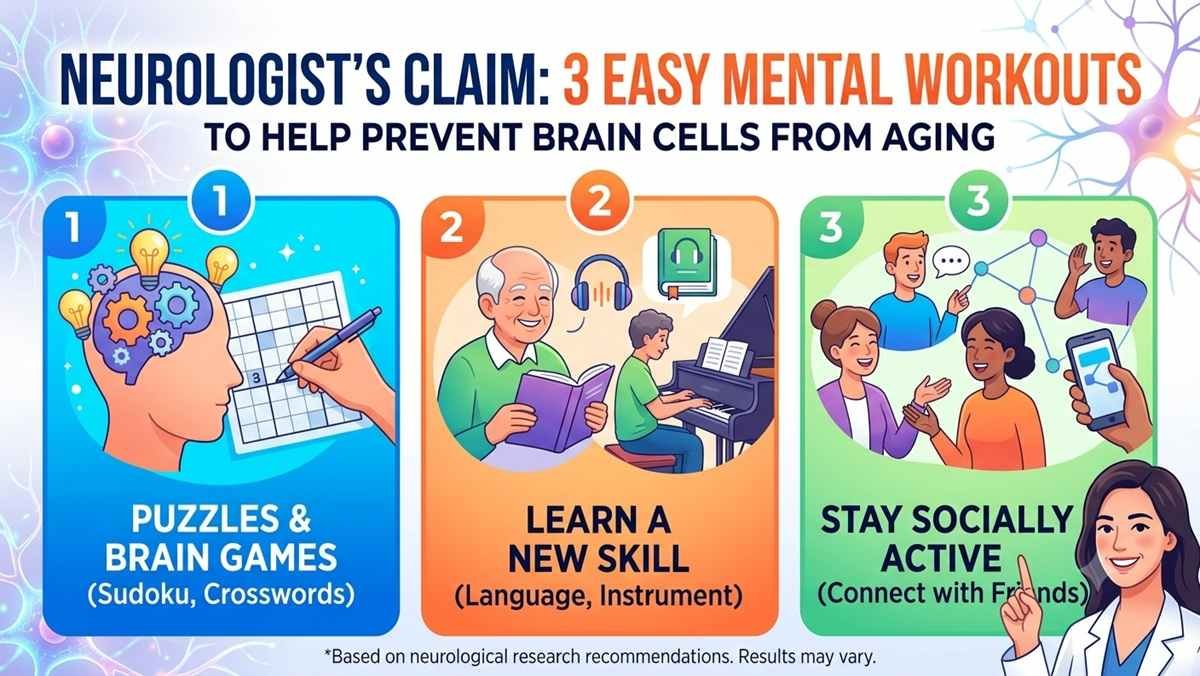
A neurologist says most people unknowingly age their brains every day. The surprising part? It isn’t caused by getting older—it’s caused by habits you probably repeat without thinking. The good news is that just three simple mental workouts may help keep your memory sharper, improve focus, and support long-term brain health. Here’s how to start today.
Key Takeaways
- Simple daily brain exercises can strengthen memory, attention, and problem-solving skills.
- Learning something new keeps brain cells active and encourages new neural connections throughout life.
- Mindfulness, sensory activities, and changing your routine help maintain mental flexibility and may protect cognitive health as you age.
Table of Contents
ToggleWhy Your Brain Needs Regular Exercise
Just like your heart benefits from walking and your muscles benefit from strength training, your brain benefits from regular mental challenges.
Scientists call this cognitive reserve—the brain’s ability to adapt, create new pathways, and compensate for natural aging. People who regularly engage in mentally stimulating activities often maintain better thinking skills later in life.
Brain workouts don’t have to be difficult. In fact, consistency matters far more than complexity.
Even spending 15 to 20 minutes a day on activities that challenge your thinking can make a meaningful difference over time.
The Neurologist’s 3 Easy Mental Workouts
1. Solve Problems Instead of Scrolling
One of the simplest ways to wake up your brain is by giving it something to solve.
Rather than reaching for social media during every spare moment, spend a few minutes challenging your mind.
Great options include:
- Jigsaw puzzles
- Crossword puzzles
- Sudoku
- Logic games
- Chess
- Card games
- Word searches
These activities activate multiple areas of the brain simultaneously, including memory, reasoning, planning, and visual processing.
Research has found that regularly completing puzzles may support healthy cognitive aging because your brain constantly searches for patterns and relationships.
Even 15 minutes a day is enough to keep your mind engaged.
2. Learn Something Completely New
One of the biggest mistakes adults make is believing learning stops after school.
In reality, your brain thrives when it’s forced outside its comfort zone.
Learning something unfamiliar strengthens communication between brain cells and encourages neuroplasticity—the brain’s remarkable ability to reorganize itself.
You don’t have to earn another degree.
Instead, try learning:
- A new language
- Guitar
- Piano
- Painting
- Photography
- Coding
- Cooking unfamiliar recipes
- Gardening techniques
Research involving older adults has shown that learning multiple new skills can significantly improve memory, attention, and overall thinking ability.
Your age doesn’t matter.
Your brain continues creating new pathways throughout life.
3. Practice Mindfulness and Focus
Modern life constantly pulls our attention in dozens of directions.
Notifications.
Emails.
Videos.
Social media.
Our brains rarely get the chance to focus deeply.
Mindfulness exercises train your attention like strength training builds muscles.
Even five to ten minutes of meditation each day may improve concentration, emotional regulation, and working memory.
Simple mindfulness exercises include:
- Deep breathing
- Body scan meditation
- Watching your breath
- Guided meditation
- Quiet observation
These exercises don’t simply reduce stress—they may also improve how efficiently your brain processes information.
What is the Best Mental Exercise?
There isn’t one single “best” mental exercise because different activities train different parts of the brain.
The most effective approach combines several types of challenges.
Examples include:
- Solving puzzles
- Reading books
- Playing strategic games
- Learning new skills
- Meditation
- Writing
- Playing music
The best mental exercise is the one you’ll actually practice consistently.
A variety of activities keeps different brain networks active and engaged.
What is a Mental Workout?
A mental workout is any activity that challenges your brain to think, remember, learn, concentrate, or solve problems.
Just as lifting weights strengthens muscles, mental workouts strengthen neural pathways.
Some examples include:
- Memorizing information
- Solving math problems
- Learning vocabulary
- Playing chess
- Card games
- Creative writing
- Brain teasers
These activities encourage your brain to process information in new ways instead of operating on autopilot.
What Exercise is Good for Anxiety?
While mental exercises improve thinking skills, combining them with physical activity can also reduce anxiety.
Excellent options include:
- Walking
- Yoga
- Tai Chi
- Meditation
- Deep breathing
- Dancing
Physical exercise increases blood flow to the brain while releasing feel-good chemicals that improve mood.
Mindfulness exercises also help interrupt racing thoughts, making them especially useful for people experiencing everyday stress or anxiety.
What is the 7 Minute Brain Exercise?
A quick seven-minute brain workout can help sharpen your focus without taking much time.
Try this routine:
Minute 1: Deep breathing
Minute 2: Memory recall (remember yesterday’s activities)
Minute 3: Mental math
Minute 4: Learn five new vocabulary words
Minute 5: Solve a short puzzle
Minute 6: Observe your surroundings and notice five details
Minute 7: Close your eyes and visualize your daily schedule
This simple routine activates several different cognitive systems in just a few minutes.
5 Brain Exercises That Support Long-Term Brain Health
If you’re looking for 5 brain exercises, these evidence-based activities are a great place to start.
1. Jigsaw Puzzles
Puzzles improve visual reasoning, attention, and problem-solving.
2. Card Games
Games like bridge, solitaire, poker, hearts, and gin rummy strengthen planning and decision-making skills.
3. Learning New Words
Expanding your vocabulary challenges language centers in the brain.
Keep a notebook nearby while reading and write down unfamiliar words.
4. Music
Playing an instrument or singing stimulates memory, coordination, and creativity.
5. Meditation
Mindfulness improves attention, emotional regulation, and mental clarity.
5 Brain Exercises at Home
You don’t need expensive equipment to keep your brain active.
These 5 brain exercises at home are simple enough for anyone.
- Read a chapter from a new book every day.
- Complete a crossword puzzle.
- Cook a completely new recipe.
- Rearrange household objects from memory.
- Learn ten words in another language.
Small daily challenges can make your brain work in fresh and meaningful ways.
Brain Exercises for Adults
As we age, maintaining cognitive flexibility becomes increasingly important.
Some excellent brain exercises for adults include:
- Sudoku
- Crossword puzzles
- Chess
- Learning a musical instrument
- Reading nonfiction
- Joining book clubs
- Memory games
- Dance classes
- Creative hobbies
The key is choosing activities that require active thinking rather than passive entertainment.
Brain Activation Exercises for Kids
Children’s brains develop rapidly, making mental stimulation especially valuable.
Some effective brain activation exercises for kids include:
- Matching games
- Building blocks
- Storytelling
- Memory cards
- Music lessons
- Drawing challenges
- Treasure hunts
- Simple coding games
These activities encourage creativity, attention, and problem-solving while making learning fun.
5 Brain Exercises for Memory
Want to remember names, appointments, and important information more easily?
These 5 brain exercises for memory may help.
Repeat Information
Say names out loud several times after meeting someone.
Use Visualization
Turn information into vivid mental images.
Learn Poetry or Quotes
Memorization strengthens recall.
Play Memory Games
Matching card games are surprisingly effective.
Recall Your Day
Before bed, mentally review everything you did from morning until night.
This strengthens episodic memory over time.
Brain Exercises for Students
Students constantly rely on memory, concentration, and critical thinking.
Helpful brain exercises for students include:
- Mind mapping
- Flashcards
- Teaching classmates
- Reading aloud
- Timed recall practice
- Mental math
- Vocabulary quizzes
Learning becomes easier when the brain regularly practices retrieving information instead of simply rereading notes.
5 Brain Exercises for Students
These 5 brain exercises for students are especially useful before exams.
- Solve one Sudoku puzzle.
- Memorize ten new vocabulary words.
- Explain today’s lesson to someone else.
- Practice active recall without notes.
- Read for twenty minutes without distractions.
These activities improve focus and strengthen long-term memory.
Mental Exercises to Improve Memory
If remembering information has become more difficult, don’t panic.
Memory naturally changes with age, but it also responds well to regular practice.
Some excellent mental exercises to improve memory include:
- Visualization techniques
- Chunking information
- Spaced repetition
- Memory palaces
- Story-building exercises
- Learning songs
- Journaling
- Reading aloud
The more often you retrieve information, the easier it becomes for your brain to access it later.
Don’t Forget Your Senses
One overlooked way to exercise your brain is by engaging all five senses simultaneously.
Activities like:
- Baking cookies
- Gardening
- Visiting a farmers’ market
- Trying a new restaurant
- Nature walks
encourage the brain to combine smell, touch, hearing, sight, and taste into one experience.
This type of multisensory stimulation activates multiple brain regions at once.
Change Your Routine More Often
Our brains love novelty.
Driving the same route every day or following identical routines requires very little mental effort.
Instead, challenge yourself by:
- Taking a different route home
- Using your non-dominant hand
- Trying a new hobby
- Rearranging furniture
- Visiting unfamiliar places
Small changes encourage cognitive flexibility and keep your brain from becoming overly automatic.
Lifestyle Habits That Protect Your Brain
Mental workouts work best when combined with healthy daily habits.
Support your brain by:
- Sleeping 7–9 hours every night.
- Exercising regularly.
- Eating plenty of vegetables, berries, nuts, fish, and healthy fats.
- Staying socially connected.
- Managing stress through relaxation techniques.
- Drinking enough water.
- Avoiding smoking and excessive alcohol.
Your brain depends on your entire body’s health.
The Bottom Line
Keeping your brain healthy doesn’t require expensive programs or complicated technology. The most effective mental workouts are often the simplest ones: solving puzzles, learning something new, and practicing mindfulness every day.
Research continues to show that staying mentally active throughout life helps strengthen neural connections, supports memory, and may reduce the risk of age-related cognitive decline. While no activity can completely stop brain aging, consistently challenging your mind can help it stay flexible, resilient, and sharp.
Whether you choose crossword puzzles, card games, music lessons, meditation, or learning a new language, the important thing is to keep your brain curious. Every new challenge is another opportunity to build stronger brain pathways.
Think of brain exercise as an investment. Just a few minutes each day can contribute to better focus, improved memory, clearer thinking, and a healthier mind for years to come.
Read also:
https://thebrainalert.com/what-is-emotional-intelligence-eq/